This article includes a fishing news, events, and other information from the Great Lakes region in 2024.
In March, the binational Lake Erie Committee (LEC), composed of fishery managers from Michigan, New York, Ohio, Ontario and Pennsylvania, set total allowable catches (TACs) for 2024 of 12.858 million walleye and 6.554 million pounds of yellow perch.
Yellow perch are allocated in pounds and walleye are allocated by number of fish. These TACs represent a slight decrease from last year’s TACs.
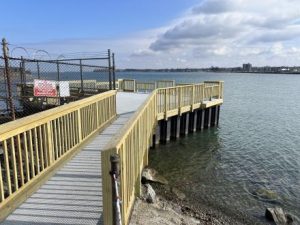
In March, the New York State Department of Environmental Conservation (DEC) announced the completion of construction of the Dunkirk Harbor fishing platform in Dunkirk, NY.
Located on the west side of Dunkirk Harbor, the newly reconstructed and reopened fishing platform pier features slip-resistant decking, two benches, solar-powered lighting, and parking for eight cars.
The structure replaces the previous platform damaged by a Lake Erie storm surge in 2020.
The new fishing platform is expected to provide anglers access to a variety of Lake Erie sportfish, including smallmouth bass, steelhead, walleye, channel catfish, bullhead, white bass, and yellow perch. Spring is usually when the greatest variety of species occurs.
In April, an angler fishing in the Mayor’s Fishing Derby in Hammond he landed a 3-pound, 2-ounce yellow perch, setting a new state record for the species.
In June, the Michigan Department of Natural Resources (DNR) announced that fisheries staff had to euthanize just over 31,000 Atlantic salmon that were sick with bacterial kidney disease, or BKD.
The Platte River State Fish Hatchery, located approximately 15 miles west of Traverse City, also reared Atlantic salmon which were unaffected by the outbreak.
Salmon from the Platte facility were stocked in Torch Lake (15,883 fish), the Au Sable River in Oscoda (25,000 fish), the Thunder Bay River in Alpena (25,000 fish), Lake Huron – Lexington Harbor (40,000 fish), and the St. Marys River at Sault Ste. Marie (26,000+ fish).
In June, the U.S. and Canadian Committees of Advisors to the Great Lakes Fishery Commission came together during the Commission’s 2024 annual meeting in Ottawa, Ontario to discuss a number of issues pertaining to the Great Lakes fishery.
This year, the committees passed four binational resolutions pertaining to issues affecting the entire basin:
- A Resolution Urging for the Transition of the Great Lakes Fishery Commission’s Canadian Budget Portfolio to Global Affairs Canada
- A Resolution in Support of Reauthorizing the Great Lakes Restoration Initiative Through the GLRI Act of 2024
- A Resolution Supporting Legislative Efforts to Establish a Canadian Version of the Great Lakes Restoration Initiative as Part of Canada’s Work to Establish a National Freshwater Action Plan
- A Resolution Supporting the Launch and Tooling of a Fully Funded, Independent Canada Water Agency with a Substantial Great Lakes Focus
The Committee of Advisors consists of both U.S. and Canadian representatives, from First Nation, commercial, recreational, academic, agency, and public fishery interests in the Great Lakes Basin. Advisors provide advice to the Great Lakes Fishery Commission.
On June 26th, Ohio Governor Mike DeWine and Lt. Governor Jon Husted celebrated the 44th annual Governor’s Lake Erie Fish Ohio Day, along with Ohio Department of Natural Resources (ODNR) Director Mary Mertz, ODNR Division of Wildlife Chief Kendra Wecker, and other leaders from the conservation and tourism industries.
The annual Lake Erie Fish Ohio Day event highlights the importance of protecting and improving Lake Erie and its great fishing.
“Fish Ohio Day is a celebration of the world-class fishing on Lake Erie and the dedication of those who work to improve the lake’s water quality, manage its fish populations, and bring visitors to the area each year,” said Governor DeWine. “This day provides a great opportunity to showcase The Walleye Capital of the World.”
The event was co-sponsored by the ODNR Division of Wildlife, Lake Erie Charter Boat Association, and Shores & Islands Ohio. Participants enjoyed walleye fishing on Lake Erie with 19 licensed charter boat captains who donated their boats, time, and experience for the event.
Lake Erie is often called ‘The Walleye Capital of the World’ and is a premier recreation destination. Ohio’s portion of the lake is known for its exceptional walleye fishing.
Each year, ODNR Division of Wildlife monitors Lake Erie’s walleye population to guide management decisions.
Walleye hatch success has been well above average for six consecutive years, including the three largest hatches ever surveyed. This summer, anglers will mostly catch abundant 2- to 6-year-old fish ranging from 15 to 24 inches.
Larger fish from 2015 and earlier hatches will provide chances to reel in a Fish Ohio qualifying walleye (minimum 28 inches).
On July 1st, the states of Illinois and Michigan signed an agreement with the U.S. Army Corps of Engineers to cosponsor the construction of the Brandon Road Interbasin Project.
The agreement unlocks $274 million in federal and $114 million in state funding for the first of three phases of the $1.15 billion project that will prevent invasive carp and aquatic nuisance species from entering the Great Lakes.
Brandon Road Lock and Dam near Joliet, Illinois, is a critical pinch point to stop invasive carp from moving into the Great Lakes. The Brandon Road Interbasin Project will implement a complex series of invasive carp and aquatic nuisance species deterrents.
On July 12th, the Great Lakes Fishery Commission (GLFC) announced that the organization will receive $1,000,000 from the State of Michigan in the fiscal year 2025 budget. Funds will support the construction of FishPass in Traverse City, MI.
The project is part of a more than 20-year restoration project on the Boardman/Ottaway River to reconnect the river with the Great Lakes. In place of the failing Union Street dam, a new fish barrier will have the capability to sort and selectively pass desirable fishes (lake sturgeon, lake trout) while blocking harmful invaders like sea lamprey.
In August, NOAA announced the availability of up to $12 million in Great Lakes Restoration Initiative funding to continue work restoring habitat for Great Lakes native fisheries. The agency is seeking proposals for projects that restore Great Lakes habitats and lead to significant and sustainable benefits for Great Lakes native fish species.
In September, Dante Piraino set a New York state record for smallmouth bass with the catch of a nine-pound smallmouth bass from the St. Lawrence River. Piraino caught the record-setting smallmouth while fishing in a bass tournament hosted in the city of Ogdensburg, St. Lawrence County.
In November, the Lake Superior Committee (LSC) announced that lake trout are fully recovered in most of Lake Superior. The LSC estimates the current abundance of naturally reproduced lake trout is at or above the best estimates of abundance prior to the sea lamprey invasion in 1938.
In December, the Minnesota Department of Natural Resources (DNR) announced that the agency stocked surplus fall fingerling steelhead in Lake Superior at Two Harbors and in the Sucker and Knife rivers.
The Wisconsin Lake Superior lake trout season opened on December 1 and is expected to run until September 30, 2025, or until the harvest cap is met.
In December, the Great Lakes Fishery Commission (GLFC) announced the annual sea lamprey abundances for each Great Lake in 2024. The report indicated that in 2024, populations of non-native predatory sea lampreys were above targets in all five of the Great Lakes.
In December, annual Lake Erie fish surveys revealed that walleye hatches were below average and yellow perch hatches were above average in two of the three management zones, according to the Ohio Department of Natural Resources (ODNR) Division of Wildlife.
Leave a Reply
You must be logged in to post a comment.