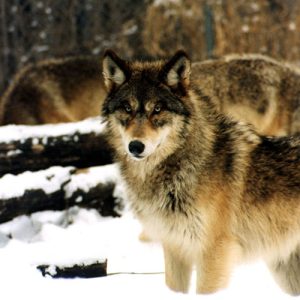
The 2024 winter wolf population survey estimate from the Michigan Department of Natural Resources (DNR) found a minimum of 762 wolves in Michigan’s Upper Peninsula.
The 2024 estimate showed an increase of 131 animals compared to the 2022 estimate of 631. The survey, completed last winter, found the population distributed among 158 packs in the Upper Peninsula, with an average of 4.8 wolves per pack.
This year’s survey represents the highest population estimate since 2012, when the department began doing the semiannual survey.
The results indicate a continued trend of stability in Michigan’s wolf population, according to Michigan DNR.
“When a wild population reaches this stable point, it is typical to see slight variations from year to year, indicating that gray wolves may have reached their biological carrying capacity in the Upper Peninsula” said Brian Roell, the DNR’s large carnivore specialist.
The survey implies that Michigan’s U.P. wolf population has achieved an equilibrium between availability of habitat and the number of wolves that habitat can support on a long term basis.
The survey is conducted during the winter because it relies in part on identifying wolf tracks in the snow.
Prior to the winter of 2007, Michigan DNR attempted to count wolves throughout the entire Upper Peninsula. However, as the wolf population increased, this peninsula-wide survey method became more difficult and time-consuming, especially the process of distinguishing among adjacent packs.
As a result, DNR managers developed and evaluated a different sampling method to reduce the search area and allow additional time to accurately count wolves in neighboring territories.
The current method uses a geographic stratification and produces an unbiased, precise minimum estimate of wolf abundance in Michigan’s U.P. during midwinter when wolves are at their lowest point in their yearly population cycle.
The DNR is currently evaluating two other techniques for estimating wolf abundance in the U.P. One relies on a track survey similar to the department’s current method. The other uses trail cameras spread across the U.P.
If successful, these additional techniques may have advantages over the current methodology, mainly by decreasing staff time. The camera model would have the added benefit of producing estimates at times of the year other than winter.
DNR is also continuing its search for wolves in the Lower Peninsula. The last survey for the presence of wolves in the northern Lower Peninsula occurred in 2019. A new survey is planned for early 2025.
Monitoring wolf presence in the northern Lower Peninsula is significantly different than in the Upper Peninsula because wolves, if present in the Lower Peninsula, are at such low-density levels the track survey protocol used in the U.P. is impractical.
Instead, a targeted search approach based on resident reports of wolves or wolf sign – such as tracks or scat – is used to concentrate efforts in areas more likely to have wolves.
DNR also plans on testing some new technology using trace DNA collected from fresh tracks left in the snow to verify suspected wolf presence.
As of April 2023, the state’s wolf population is not known to extend to the Lower Peninsula of Michigan. Evidence suggests that individual wolves may be active in the area.
During the 2011 targeted winter track survey, and shortly after the 2015 survey period, tracks consistent with a wolf were observed in Cheboygan and Emmet counties.
In 2014, biologists from the Little Traverse Bay Bands of Odawa Indians captured what appeared to be a wolf on a trail camera and were able to collect a scat sample. DNA analysis of the scat confirmed the animal to be a male wolf.
In January 2024, a male wolf taken in the Lower Peninsula by a coyote hunter. An investigation into the matter failed to determine how the wolf made it to Calhoun County.
“Research has suggested that there is suitable habitat for wolves in the northern Lower Peninsula,” said Roell. “However, this habitat is fragmented and the ability of wolves to travel the landscape among these habitat patches is uncertain. Suitable habitat becomes even more patchy in the more populated southern Lower Peninsula, which makes it unlikely that wolves would establish themselves there.”
Wolves in Michigan are currently protected under the federal Endangered Species Act by federal court order. As a result of this status, wolves can be killed only if they are a direct and immediate threat to human life.
Once among North America’s most widely distributed land mammals, gray wolves have also been among the most persecuted.
By the 1970s, Great Lakes wolves survived only in northeastern Minnesota and Lake Superior’s Isle Royale National Park.
Under Endangered Species Act protection, wolves have grown in number and dispersed from Minnesota into Wisconsin and Michigan.
For more about Michigan’s wolf population, including the Michigan Wolf Management Plan, visit Michigan.gov/Wolves.
sources: Michigan Department of Natural Resources, U.S. Fish and Wildlife Service
Leave a Reply
You must be logged in to post a comment.